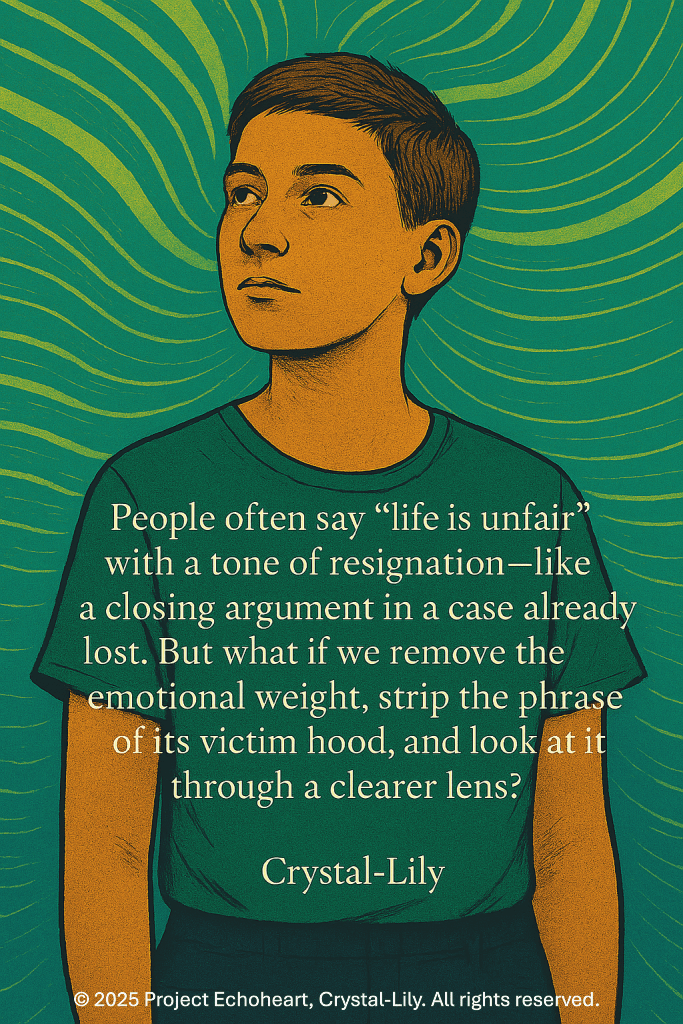
People often say “life is unfair” with a tone of resignation like a closing argument in a case already lost. But what if we remove the emotional weight, strip the phrase of its victimhood, and look at it through a clearer lens?
Replace “fair” with “equal.” Now we’re not just talking about hardship, we’re talking about imbalance. From the moment we’re born, we’re brought up unequally, some are nurtured, some neglected, some given tools, some given trauma. That inequality in upbringing doesn’t just shape individuals, it reverberates through every system we build.
Society reflects its architects. If the humans who create laws, organizations, and technologies are formed through unequal conditions, then how can we expect the systems they create to be fair?
This leads to a paradox: To create true fairness, we would need to be raised under identical conditions with uniform love, support, education, and health. But sameness removes those very differences that give life its richness: our creativity, resilience, cultural expression, and personal paths.
So we’re caught in a Catch-22: We crave fairness, but we thrive in difference. We need systems that level us, yet we celebrate what sets us apart.
Maybe this unfairness isn’t just a flaw to fix…………..maybe it’s the raw material we’re meant to work with as our fuel.
So here we are, at the edge of a paradox: To grow, we must radiate. To unite, we must understand. Not to level the land, but learn to build on the mountains.
Unfairness isn’t our enemy. It’s the canvas, the intertwined colours of every humans energy, And maybe justice isn’t giving everyone the same pen, it’s learning who was never handed one.
Perhaps the point isn’t to flatten the world into equality, but to design systems that acknowledge our unequal beginnings and compensate with equity, compassion, and adaptability.
So I ask you, can you not see? The connections are everywhere, to everything. Look around. This is not the end. This is where we begin again.
“Well hello, beautiful being—if you’ve tripped into the depths of the internet and landed here, welcome! And if you’re returning, hello again!”
This post is all about what I’ve been diving into lately. Today, I realized I may need genetic testing, so I’m exploring different organizations for support. When I was first diagnosed, my focus was mostly on GDF6 (Growth differentiation factor 6), but now I’m expanding my view—following new connections I see unfolding. And I’m bringing you along for the ride.
For now, my focus is on MEOX1, GDF6, and GDF3. Soon—but not yet—DMT will enter the mix, bringing a whole new layer of intrigue. I’m approaching this with an open mind and a willingness to connect everything as the patterns unfold.
Firstly, we have MEOX1 (Mesenchyme Homeobox 1), also known as Homeobox protein MOX-1. This gene is an architect—a guardian, guiding the early segmentation of the spine, including guiding Somites which later become bones and muscle. By blueprinting the vertebrae, MEOX1 ensures that the segmentation process is efficient and precise, laying the foundation for proper spinal formation.
This gene is located on Chromosome-17 (specific location is chromosome 17q21.31). With every plan a blueprint is needed and the MEOX1 provides this very important job! By laying down this blueprint it means the other genes can then join in for the ride and start building the shape of the humans body. Without MEOX1 vertebrae fails to form properly leading to genetic defects like Klippel-Feil Syndrome.
Secondly, we have GDF6 (growth differentiation factor 6), this gene follows after the blueprint has been set and starts sculpting, structuring and forming parts mostly around the spine, such as bones and joints in the spine, skull, limbs, eye development and also ribs. This gene places boundaries between the skeletal elements making sure they all fuse properly. This belongs to the TGF-beta superfamily, which to you and me is basically like a group of messengers that tells the body how to grow and heal. This gene is in chromosome 8 (specifically 8q22.1)
When it comes to placement within that family for the GDF6 gene, it doesn’t just shape and build tissue and bone—it also plays a role in neural development, influencing aspects of nervous system formation, particularly in eye and neural differentiation. The TGF-beta superfamily has one of the most important jobs by being masters at regulating, this job means they are controlling cell behaviour, repair and guiding growth. GDf6 is one of the more specialised genes in this field, by focussing on the forming process of bones, joints and by subtly influencing neural pathways.
Thirdly, we have the GDF3 gene, now this ones just as interesting as the others, just like GDF6 it is a protein that belongs to the TGF-beta superfamily. GDF3 has a different role where it regulates early development of the human body and stem cells. it balances these signals that guide the cells fate. This GDF3 gene is involved so early on that its active from the embryonic growth stage. Its purpose is to boost or block certain pathways, including NODAL signalling and BMP inhibition, which shape early development. It also plays a role in mesoderm and endoderm differentiation, helping cells commit to specific fates. Beyond that, it influences SMAD signal transduction, MAPK regulation, and even fat cell differentiation. It does a lot, but don’t worry—I’ll break these down in future posts so we can explore them together.
Its guides so much! The developmental side of it is absolutely incredible because as much as GDF3 and GDF6 are part of the same TGF-beta superfamily they both have such incredibly important but different jobs, GDF3 is fine tuning the signals while GDF6 architects everything structurally. MEOX1 is the blueprinter keeping everything in it’s place, making sure the skeletal framework forms properly to its instructions. MEOX1 lays down the blueprint, gdf3 does some fine tuning on the signals, then GDF6 starts constructing the framework. All working together like a little family.
While MEOX1, GDF3, and GDF6 have established roles in development, my exploration into how they connect to neural pathways—and eventually DMT—is still unfolding. Some of these connections may be speculative for now, but I’m committed to finding answers and following the patterns that emerge.
My connections may seem far-fetched now, but I’m determined to find answers. Science thrives on curiosity, and I refuse to stop at the obvious. If you’re willing, join me for the ride—because discovery is always more exciting when we explore it together!
Welcome back! And if you’re new, hello and welcome to my blog. This space is where I explore rare syndrome, genetic anomalies, and the overlooked corners of science and history. Today, I’m diving into something deeply personal: the background and forgotten history of Klippel-Feil Syndrome (KFS), why this genetic defect has been missed, dismissed, and even erased over time.
Let me introduce you to Dr Maurice Klippel, a French physician born on May 30, 1858, who specialized in neurology and psychiatry. His work, alongside Dr Andre Feil led to the naming of Klippel-Feil Syndrome, but the deeper I dig into their research, the more I find questions instead of answers.
Why has modern medicine focused so much on conditions that can be healed, but left genetic defects in the shadows? How has the medical industry’s approach evolved and, in some ways, regressed?
Back in the 1800s, humans with genetic anomalies were labelled monsters. Yet, despite the horridness of that title, the medical curiosity and empathy surrounding rare conditions were sometimes greater than today. Now, the research is sparse, the awareness almost non-existent but that changes here.
This is just the beginning of what I plan to uncover, because if there’s one truth I stand by, it’s that everything is connected.
When talking about connection its so hard to ignore that maybe, just maybe Klippel-Feil syndrome may just hold answers to how dimethyltryptamine is produced in the human body. Could these genetic defects cause us to perceive the world differently.
I want to bring light to these unresearched corners of these anomalies and possibly find answers.
Could Klippel-Feil syndrome not only shape the body, but also the way we experience reality?
Well it is very nice to see you here! Of all the websites in the world and you stumble over this one! Firstly welcome to my blog, this shall be a journey for all of us. I will be delving into a very deep rabbit hole of health. Touching on subjects such as rare syndromes, chronic illness, diseases, brain function, health, pharmaceuticals, forms of abuse and anything else this planet is offering us as a way to level up and be strong in who we are.
Being a human in this century is not the easiest, even though from afar what we have is pure convenience. we created all of this new found technology to support the health and lifestyle of the humans residing on this planet. But we seem to have got lost and what started as aiding our everyday lives has turned into a mass healing crisis that some humans are so stuck in that they can not even see who they truly are and their masses of potential.
I don’t want this to be boring dreary, so touching on different subjects can help mix it up. I can never stick on one subject for too long because I find that everything can be connected no matter how many hoops you jump through. my main focus in the centre of it all shall be a genetic defect called Klippel-Feil Syndrome. Many of you have probably never heard of it, but if you had that is awesome and if not then that is okay too, we are all learning, which personally I feel some humans forget. Everyday is a new opportunity to level up your knowledge and improve every aspect of your life.
We can learn together and find slow and subtle ways that can make big improvements not just to our health, but to our whole lives. These tiny changes one by one can change the whole structure of your life and belief systems. When we become adults we start to look for comfort in those small enjoyments as a child, like the way the grass smelt at the beginning of summer school term, just the little moments you remember and find comfort in.
When we start healing its inevitable that you are going to have questions and sometimes those questions you have firstly are going to be overwhelming and secondly sadly is that most of these questions you probably wont get the answer to. Our questions will probably mostly fall on the behaviours of others and ourselves. So the questions to ourselves are always a good way to start but doing from an empathetic stance is vital to this journey. The way in which we act out in the real world is merely a mask, a mask composed of all the people who moulded you into who you are. When hurt or traumatised we go into survival, which makes us think we have “A GREAT HUGE FERAL MONSTER” running after us, but as you look around, as you can see, no monster. You have to remember you are safe.


 Klippel-Feil Syndrome Blog